
atmos:citation:instruments:vaisalahmk15calibrator:home
This is an old revision of the document!
Table of Contents
Vaisala HMK15 Humidity Calibrator
- Description: Calibration set up for Vaisala Humidity Sensors
- Manufacturer: Vaisala
- Manufacturer Spec Site: Vaisala HMK15 Humidity Calibrator
- Model: HMK15
- Manual: HMK15 User Guide
Parts


- Main Board
- Salt Solution Chambers (x2)
- Sensor Cap Attachment (x2)
- Sensor Cap Plugs (x10)
- Thermometer
- Measuring Cup
- Plastic Probe/Stirring Stick
- Adapter Rings (x3)
- Salts
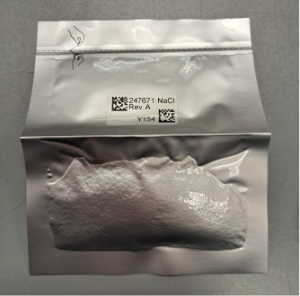
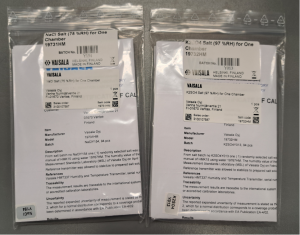
- NaCl (75% RH)
- K2SO4 (97% RH)
- All available salts
- Lithium chloride LiCl (11% RH)
- Magnesium chloride MgCl2 (33% RH)
- Sodium chloride NaCl (75% RH)
- Potassium chloride KCl (85% RH)
- Potassium sulphate K2SO4 (97% RH)
- Calibration/Preparation Date Tags
- Certificate of Calibration/Inspection


Calibration Process
Need:
- HMK15 Humidity Calibrator
- Vaisala Humidity Sensor
- Deionized water
Steps:
- Prepare salt solutions
- Take the calibrator out of the box and place it on a clean, even surface.
- Remove the transit cover of the salt chamber.
- Remove the chamber lid from the chamber holder and put it aside.
- Press the transit cover on the chamber holder.
- Pour the required amount of ion exchanged water into the salt chamber.
- LiCl: 12 ml
- MgCl2: 3 ml
- NaCl: 10 ml
- KCl: 10 ml
- K2SO4: 10 ml
- Sprinkle the contents of a salt package (or measure the required amount of salt 1) in small quantities into the chamber, stirring constantly.
- LiCl: 15 g / 18 ml
- MgCl2: 30 g / 30 ml
- NaCl: 20 g / 15 ml
- KCl: 30 g / 30 ml
- K2SO4: 30 g / 20 ml
- When measuring with the measurement cup, make sure that the cup is clean and dry. Rinse and dry the cup after every use.
- When all the salt has been sprinkled into the chamber, the saturated salt solution should have a ratio of 60… 90% undissolved salt to 10…40% liquid.
- Close the salt chamber with the chamber lid.
- Fasten the salt chamber on the holder in the base plate and close the measurement holes with rubber plugs.
- The chambers can also be used individually, without the base plate.
- The rubber plugs have three steps, each of which is suitable for a certain hole diameter: the first step for the 12 mm (0.47 in), the second step for the 13.5 mm (0.53 in), and the third step for the 18.5 mm (0.73 in) hole.
- Keep the holes always closed when not calibrating.
- Write the preparation date on a sticker and use it to mark the chamber. If you use a ready-dosed salt package, use the sticker with the batch code. Mark all parts of the salt chamber (chamber, chamber lid, and transit cover) with stickers. This way, the lids/covers and different salts do not get mixed.
- Allow approximately 24 hours for stabilization before use so that the salt solution reaches the equilibrium humidity.
- Depending on the frequency of use and the general operating conditions, the salt solutions maintain their characteristics for 6 - 12 months, after which they must be replaced. Perform a visual check every 2 - 3 months. There must be a minimum of 10 % of undissolved salt at the bottom of the chamber (max. 90 %). The salt must be clean, otherwise it must be reprepared.
- Calibrate Instrument
- Remove the cover from the end of the thermometer and flip it around the other way.
- Complete the following steps twice, once for each solution
- Insert the thermometer into the largest hole of the calibration cover of the solution.
- Remove the cover on the probe and insert into the calibration cover.
- Wait for the reading to stabilize, and record both the humidity reading and the temperature
- This could take 10-30 minutes
- Repeat for the second solution.
- Adjust instruments
- Using the values you recorded and the following table, find the equation to adjust readings from the probe.
- It will follow the form:

atmos/citation/instruments/vaisalahmk15calibrator/home.1786731967.txt.gz · Last modified: 2026/08/14 18:26 by ashley.vos