Setting up the Vaisala Temperature and Humidity Probe
Parts
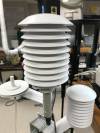
The Vaisala temperature and humidity probe has a few key components when it comes to setting up the instrument.
- Sensors and Sensor Cap/Shield - The shield/cap protects the sensors from damage, while the sensors collect data on temperature and humidity.


- Shield - Protects the entire upper area of the apparatus from harsher conditions.
- Wires - At the end of the cord, there will be seven (7) exposed wires of the following colors: clear (no plastic covering), green, yellow, blue, white, red, and black.

- Clear - Shield wire: it protects the other wires from interference from the surroundings.
- Green - [Needs to be updated]
- Yellow - Temperature Signal
- Blue - Humidity Signal
- White - Grounding Signal wire
- Red - Power (positive)
- Black - Grounding power (negative)
Setting up the Probe
By now, you should have your Raspberry Pi computer completely set up, with a DAQ HAT. To continue, you will need:
- some sort of DC Power Jack connector,

- a small screwdriver for undoing and tightening the screws on the DAQ HAT channels,


Optionally:
- a multimeter/power sensor,

- some apparatus that can introduce humidity (e.g. a half-full gallon of water),
- and an apparatus that can introduce heat (e.g. a heat gun, or even your hand).
- Connect the DC Power Jack to power
- Connect the red wire to the positive connection
- connect the black wire to the negative connection
- Optional: If you would like to test the probe prior to connecting it, follow this step. You will need the optional materials. If you do not want to test the probe, skip to step 3.
- Temperature
- Using the multimeter, connect the clamps to the exposed ends of the yellow and white wires.
- Change the setting till you see a readable number.
- Using your heating apparatus, gently heat the probe and observe the signal increase
- Humidity
- Connect the multimeter's clamps to the exposed ends of the blue and white wires.
- Change the setting till you see a readable number.
- Using your humidity apparatus, carefully introduce the sensor to a humid environment and observe the signal increase.
- Wire the probe into the DAQ HAT
- Connect the yellow wire to CH4
- Connect the blue wire to CH5
- Connect the white wire to GND, next to CH5
- If you have properly set up the ADPAA and DAQ HAT, you can now run the python program that coincides with your instrument and observe the data.